If you’ve been in business for more than a few years, I’d be willing to bet your tech stack today looks nothing like it did when you started.
Tools get added. Needs change. Offers evolve. And somewhere along the way, what started as a simple setup becomes a collection of subscriptions, logins, and workarounds that you’re not quite sure how to untangle.
That’s exactly what happened in my business. Every tool I added made complete sense at the time. There was a real problem. I found a solution. Done. But what made sense at the start gradually stopped making sense as the business grew – and I held on longer than I should have.
In this article I’m sharing the full story – why tech stacks change over time, what that looked like for me at Streamline For Success, and what I eventually did about it. If you’re feeling like your current setup isn’t quite serving you anymore, hopefully this helps. 🙂
Free 2-Min Check – From Mandy
Not sure if your CRM is still right for you?
Get clear on whether to fix what you have – or switch.
Answer a few quick questions and get your personalised results in minutes.
Why Service-Based Businesses Outgrow Their Tech Stack (And Their CRM)
If your tech stack is feeling a bit messy right now, I want you to know -you probably haven’t made bad decisions. You’ve just made decisions for a version of your business that has since moved on. Here are the most common reasons this happens:
- Your offers change. Maybe you started with pure 1:1 services and have since added a group program, a course, or a membership. Or you went from doing one thing to offering multiple service tiers. Each of those shifts changes what you need your systems to do. A booking tool built for a simple service calendar doesn’t necessarily handle course enrolments. An email platform that worked for a small list doesn’t always scale well to a full nurture sequence. What served you at one stage can quietly become the thing holding you back at the next. That’s exactly what happened in my own business – I started with purely 1:1 client work, and by the time I had courses and a membership running, the setup I’d started with wasn’t keeping up.
- Your volume changes. When you have a small handful of clients or leads, you can manage a lot manually. You can follow up from memory, send personalised emails one by one, and keep on top of it all. But as enquiries increase, as your list grows, as more people move through your business at once – manual stops working. Not because you’re disorganised. Because it was never designed to handle that volume. Things start to fall through the cracks, follow-ups get missed, and the client experience becomes inconsistent.
- Your needs change. Early on, a basic CRM and an email tool might be all you need. But as the business grows, so does the wish list. You want to send SMS reminders so clients actually show up to their calls. You want automated onboarding so new clients get a great experience without you manually sending welcome emails. You want a proper landing page with split testing so you can see what’s actually converting. You want Instagram DM automation so leads don’t go cold while you’re busy delivering. And if you bring on a team member or VA, suddenly your systems need to be clear enough for someone else to use – not just you holding it all in your head. These aren’t luxuries – they’re the things that make a real difference to your results. And if your current stack can’t do them, you either add more tools or you go without.
- The tech starts to overwhelm you. This one doesn’t get talked about enough. As your stack grows, so does the mental load of managing it. Multiple logins. Multiple support contacts when something breaks. Multiple tools to learn when you bring on a new team member. A growing list of integrations to maintain. At some point, the complexity of managing the tools starts to cost you more time and energy than the tools themselves are saving. If you’ve ever felt like you’re spending more time managing your tech than running your business – this is why.
- What’s possible changes. This one is easy to underestimate. The tech available to small business owners today is completely different from what existed even five or ten years ago. When I started Streamline For Success in 2014, getting your CRM, landing pages, course platform, SMS, booking system, and reporting all talking to each other meant stitching together half a dozen separate tools – and hoping they didn’t break. Now? A single platform can handle all of that, often at a lower total cost than the patchwork you’re currently running. Sometimes your stack isn’t just outdated for your business. The whole market has moved on and there are better options available now.
- The cost adds up. Each subscription feels manageable when you sign up. $49 here, $79 there, $99 for the course platform. But add them all up and you might be surprised by the total – especially once you factor in tools that overlap in what they do, or ones you’re paying for but barely using. At some point it’s worth sitting down and doing the actual maths. For a lot of business owners, consolidating to one platform doesn’t just simplify things – it saves real money every month.
The honest truth: most business owners don’t build their tech stack deliberately. They build it reactively -one problem, one solution at a time. And there’s nothing wrong with that. The issue is when you never stop to look at the full picture.
Here's What It Looked Like in My Business
I came into this business already owning Keap – a CRM (Customer Relationship Management) and marketing automation platform – and it carried over from a previous venture (a whole other story for another day!). Keap was the core of my business for 10 years. The CRM itself didn’t change – we just had to keep bolting things onto it as our needs grew. I wasn’t shopping for a CRM. I had one that worked, I knew it inside out, and I built everything else around it.
In the beginning, everything else was manual. Appointment scheduling meant back-and-forth emails. “Are you free Thursday?” “What about Friday afternoon?” When the volume was low, it was fine. When it stopped being low, it became the first thing I fixed.
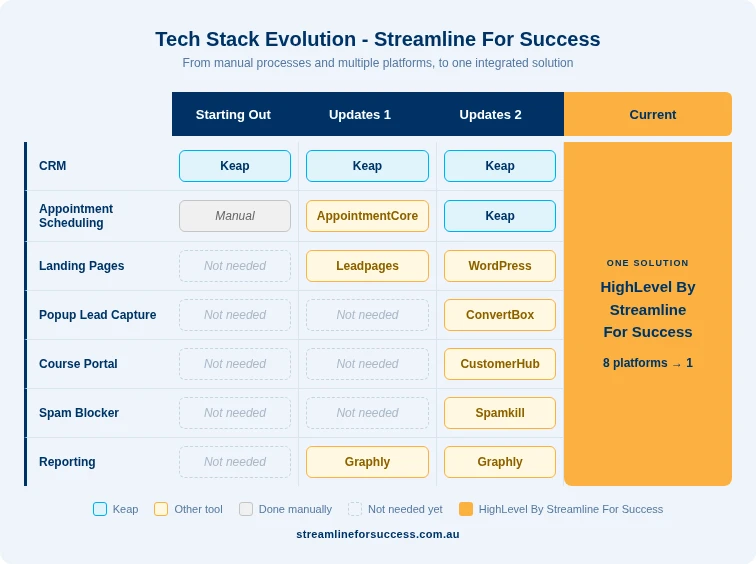
Here’s how the stack grew over time:
Starting out:
- Keap as the CRM (always the backbone)
- Manual appointment scheduling
- Everything else: not needed yet
First round of additions:
- AppointmentCore -to finally stop the scheduling back-and-forth
- Leadpages – as I started generating leads more intentionally
- Graphly – because Keap’s built-in reporting wasn’t giving me the visibility I needed
As the business grew more:
- CustomerHub – we launched our first course, then a second, then a monthly membership
- WordPress – replaced Leadpages to save costs… but that created its own headaches (no easy split testing, no straightforward conversion data)
- ConvertBox – for popup lead capture on the website
- Spamkill – to manage the spam coming through
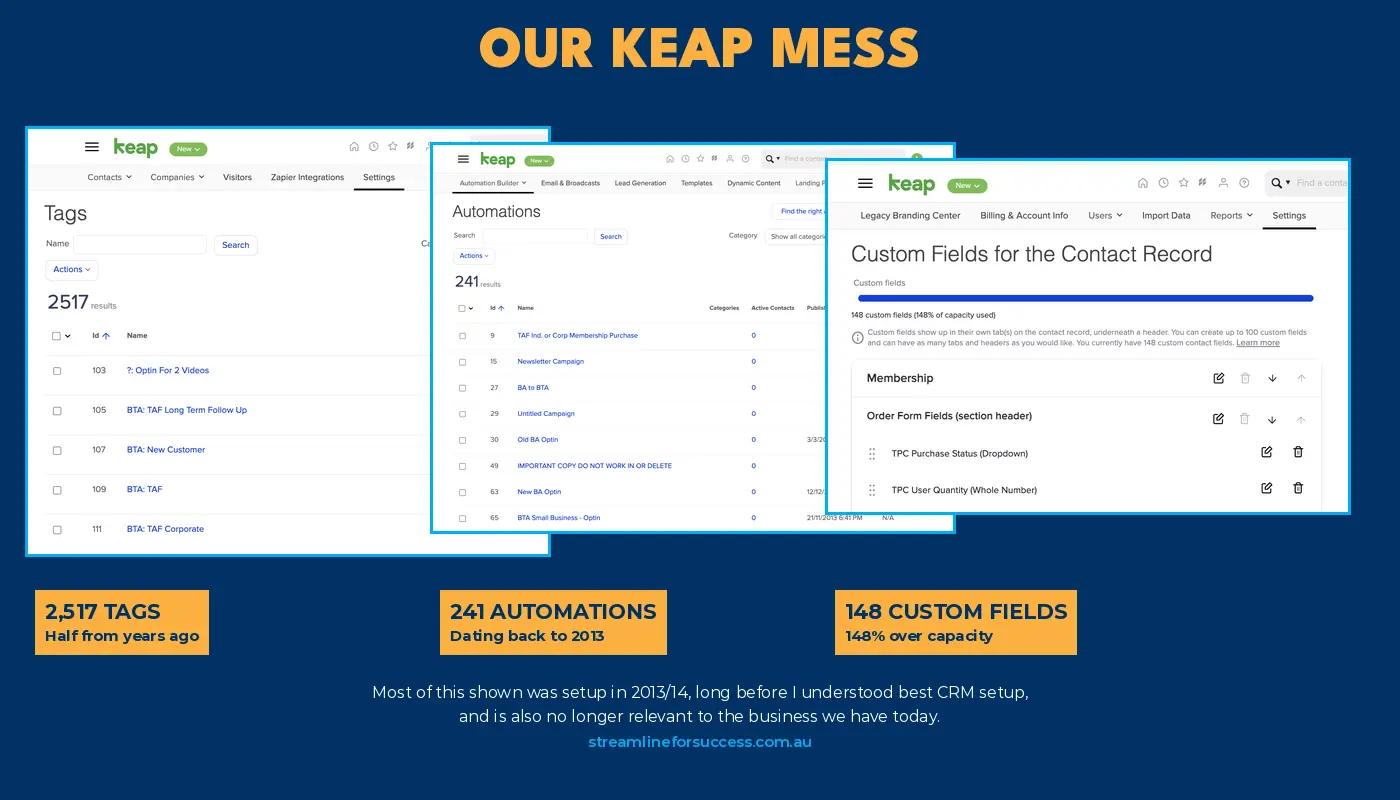
Every single addition was justified. But looking at it all together? It was a lot. Multiple platforms, multiple invoices, multiple things to maintain and log into.
Here’s a snapshot of what 10 years of bolting things on actually looks like:
How I Knew It Was Time to Switch Platforms (And What Took Me So Long)
The bill was the first trigger. Seeing the full number – not each subscription individually, but all of them together – made it real. I’d been hearing other business owners talk about cutting their software costs, and I knew there had to be a smarter way.
But honestly? The bigger factor was what was happening with Keap itself.
Keap was acquired by Thryv. And after that, development slowed substantially. Their infrastructure was built on technology that was, in some cases, 25 years old. The platform just wasn’t keeping up. I started asking a question I’d never had to ask before: what happens to my business if this platform stops evolving?
That’s not a small question when your entire client operation has run through the same CRM for 10 years. I wasn’t in panic mode – but I was paying attention. And when you put mounting costs, persistent feature gaps, and genuine concerns about a platform’s future all together, the decision to find something better becomes a lot easier to make.
But here’s the thing I want to be honest about: it wasn’t a decision I made overnight. This was months of it sitting in the back of my mind. I’d think about it, get busy, push it aside, think about it again. Sound familiar?
And in that time? I kept paying for subscriptions I knew I’d be cancelling eventually. I kept missing opportunities I could have been capitalising on with better functionality. Looking back, the delay probably cost me a few thousand dollars in wasted costs alone – not to mention the revenue I wasn’t generating because the tools weren’t there yet.
So if you’re reading this and thinking “yes, I know I need to sort this, but…” – I completely get it. The switching cost feels big. The disruption feels risky. The timing never feels perfect. But in my experience, the longer you wait, the more it may cost you – in money, in lost opportunity, and in the mental load of knowing it needs to happen.
Sometimes the biggest cost isn’t changing systems too early – it’s staying too long trying to force old systems to support a business that’s already evolved.
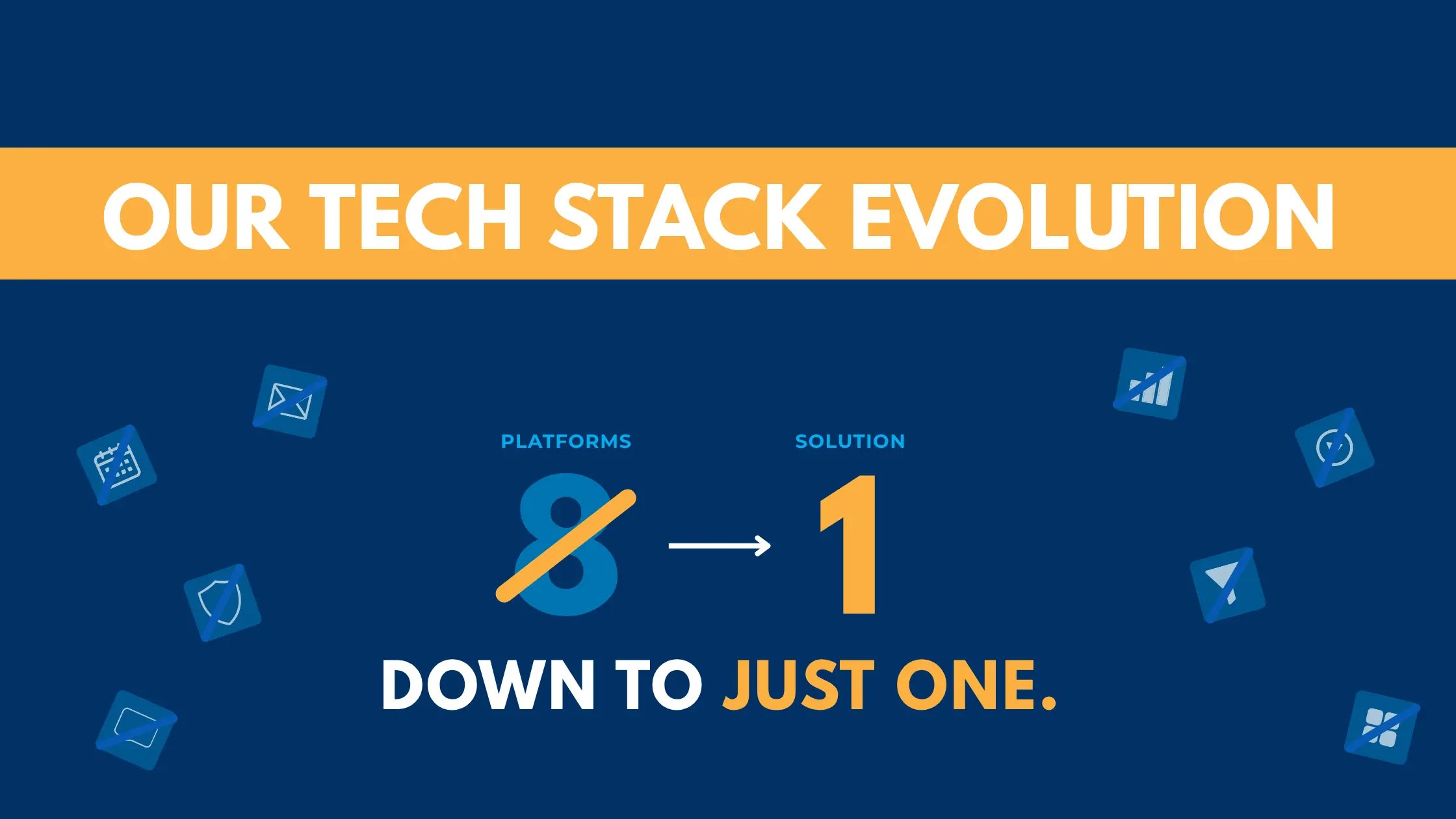
Going From 8 Platforms to 1: What We Replaced and What We Finally Got
We moved everything to HighLevel -specifically, HighLevel By Streamline For Success, our own configured instance built around how service-based businesses actually operate.
Here’s what the move looked like in practice:
| What It Replaced | HighLevel By Streamline For Success |
|---|---|
| AppointmentCore | Appointment booking |
| Leadpages + WordPress landing pages | Landing page builder with split testing & conversion data |
| ConvertBox | Popup lead capture |
| CustomerHub | Course & membership portal |
| Spamkill | Spam filtering |
| Graphly | Reporting & dashboards |
| Keap (CRM) | CRM, everything in one place |
| Manychat (was on my radar but never started) | Instagram & social DM automation, built in |
| No SMS in Keap | SMS, sent directly from the platform |
8 platforms down to 1. That’s what this move looked like in practice. One platform. One subscription – at a significantly lower total cost than what I was paying across all those separate tools. And for the first time, everything was actually in the same place.
But the real win wasn’t just replacing what already existed. It was finally getting what had been missing.
SMS – built in. Instagram DM automation – built in. Landing page split testing with real conversion data – built in. The functionality I’d been working around for years, or going without entirely, was already there waiting for me.
What Didn't Change: The Core CRM Requirement That Outlasted Every Tool
I want to be upfront about something. The title of this article says “without changing our core CRM” – but we did, eventually, change the platform.
What didn’t change was the requirement. A reliable, central CRM was always the backbone of this business. That need never went away. What changed was the tool we used to meet it – because the old tool stopped meeting it after 10 years.
This is the mindset shift I’d encourage if you’re looking at your own stack. Your tools are not your business. They’re how you run it. When a tool stops serving that purpose – whether because your business has grown, your needs have shifted, or the platform itself has changed – swapping it out isn’t starting over. It might just be the right next step for your business. (Not sure? That’s exactly what the free audit below is designed to help you figure out.)
Is Your Tech Stack Keeping Up With Your Business?
If your tech stack feels a bit duct-taped together right now, you’re not behind. You built what you needed when you needed it. That’s how it works for most of us – me included!
The question worth sitting with is: does my tech still fit the business I have now, or the business I had a few years ago?
If the answer is “a few years ago” – that’s worth looking at.
We now offer HighLevel By Streamline For Success as a done-for-you setup for service-based business owners who are ready to stop patching and start running on a platform that actually fits where they are now. It’s what I moved my own business onto -and it’s been a game changer.
If you’re not quite sure whether a switch makes sense for you yet, start here:
Not sure if it’s time to switch?
Take our free 2-minute audit and get a personalised result – find out whether it’s time to move or stick with what you’ve got.
👉 Click here to complete your free Should I Switch check
Already know it’s time? Book a free call and let’s talk about what’s possible.
👉 Book a call now
Frequently Asked Questions
How do I know if it’s time to switch my CRM or business tech stack?
A few signs worth looking at: you’re paying for multiple tools that don’t talk to each other well, there are things you need your systems to do that they simply can’t, you’re spending more time managing your tech than benefiting from it, or the platform you’re on has stopped evolving. If any of those ring true, it’s at least worth taking stock of what you have. Our free 2-minute Should I Switch audit is a good place to start – it gives you a personalised result based on your specific situation. Link to Should I Switch survey
Is HighLevel By Streamline For Success a good CRM for coaches and consultants in Australia?
It’s been the right fit for my business and for the clients I’ve moved across to HighLevel By Streamline For Success. The reason it works well for service-based businesses is that it brings together the things that typically require multiple separate tools – CRM, appointment booking, landing pages, course and membership hosting, email marketing, SMS, and reporting – into one platform. Whether it’s right for your specific business depends on where you’re at and what you need. That’s what the free audit helps you figure out.
How much can you save by consolidating your business tech stack?
It depends on what you’re currently running. In my own case, moving from 7 separate platforms to HighLevel resulted in a significantly lower total monthly cost. If you’re running 4 or more separate tools, it’s worth adding up exactly what you’re spending across all of them – the total is often higher than people expect, especially once you factor in overlapping tools and ones you’re barely using.
What is the difference between Keap and HighLevel?
Keap is a CRM and marketing automation platform – solid, well-established, and one I used for 10 years. It does what it does well. HighLevel covers more ground: CRM, landing pages, course hosting, booking, SMS, advanced automation, and reporting are all in the one platform. For businesses currently stitching those things together across multiple tools, that consolidation is the main practical difference. Whether that matters for your situation depends on what you’re running right now.
What is HighLevel By Streamline For Success?
It’s our own version of the HighLevel platform, set up for Australian service-based business owners. Most people find it easier to get into than they expected. Every subscription includes 24/7 chat support, monthly calls, and resources to help you get it configured for your business. If you want to find out if it’s a fit, the Should I Switch audit is a good starting point.
About Mandy Brasser
Mandy Brasser is the founder of Streamline For Success, an award-winning CRM and automation consultancy for established Australian service-based business owners. Since 2014, she has helped coaches, consultants, and practitioners across Australia design, build, and simplify their business systems – from Keap implementation and automation through to full tech stack consolidation on HighLevel By Streamline For Success.